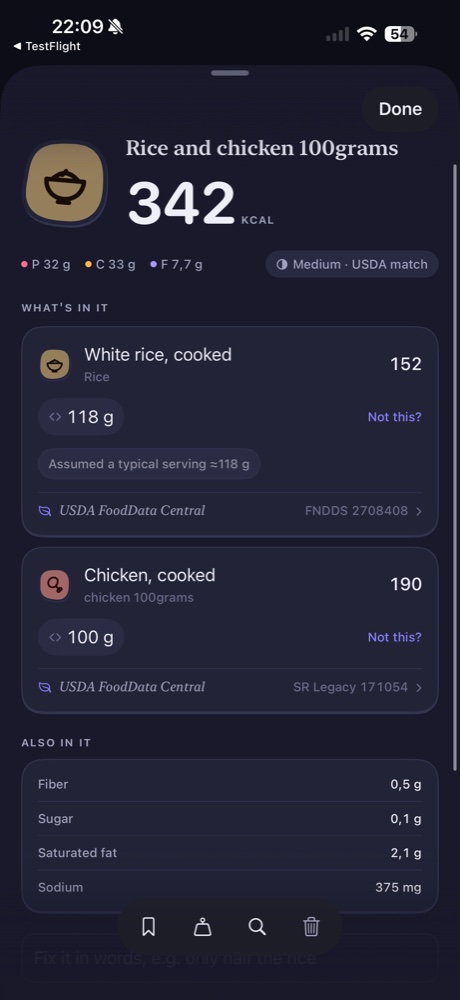
A dish name can hide several decisions: the ingredients, how they were prepared and how much of each was served. Logging a mixed meal is easier to review when those decisions are visible. Morsel’s detail sheet can break a composite entry into matched foods with individual portions and nutrition values.
Describe the meal at the level you know
If you know the components, name them. If you know their amounts, assign the amount to each food. “Rice and chicken 100grams” leaves room for interpretation: does 100 g refer to the chicken or the whole dish? Separate descriptions make that clearer.
If you do not know the recipe, do not invent ingredient weights to make the entry look exact. Start with the dish description and review the assumptions. A stated estimate is easier to revisit than an unexplained precise-looking number.
Open the ingredient breakdown
Tap the entry’s value and look at what is included. In the supplied example, the rice-and-chicken entry is divided into cooked rice and cooked chicken. The rice is assigned a typical serving; the chicken has its own weight. Each can be reviewed separately.
Check for omitted components as well as incorrect ones. If a dish included a sauce or side that is not represented, describe it in the correction. If the app selected the wrong preparation, fix that rather than only changing the total.
Understand what confidence can tell you
The app shows a match confidence label alongside the food source. Use that as context for your review. A source label identifies the selected data record; it does not establish that the portion describes your particular plate.
USDA documentation distinguishes several types of food records. The practical question for a journal entry is still whether its food description and amount fit your meal, rather than whether the database name looks familiar.
Use deeper estimates when appropriate
Morsel Pro includes Think harder, described in the app as a deeper estimate for tricky dishes, ingredient by ingredient. Treat that as another tool for examining a difficult entry, not a guarantee of laboratory-level accuracy. You can still make a correction when you know something the estimate does not.
For meals you make repeatedly, decide whether a saved combination or a recipe is the better fit. Read saved meals versus recipes and food portion checks.
Source: USDA FoodData Central data documentation.